Carl Hewitt
14 Jan 2023 - 12 Dec 2025
- MIT Computer Scientist, best known for development of the Actor model of computation, which was hugely influential and still continues to be. A very idiosyncratic thinker, with a nose for important big ideas. Died at the end of 2022: Carl Hewitt Obituary (1944 - 2022) - Aptos, CA - Santa Cruz Sentinel. It's a bit hard to appreciate today, when every toaster is connected to the internet, how visionary and forward-thinking his thinking about distributed computing was in its day. Basically he foresaw this world and tried to develop intellectual tools for building and controlling it.
- Like many of the early CS pioneers his vision has yet to see full fruition. There are many languages and systems that incorporate something called actors, but that is different from an actual actor-based system, something that has that kind of radical distributedness build into the foundations. Here's one recent effort that seems in the right spirit: Growing a Networked Garden with Spritely Goblins -- Spritely Institute
- Carl had a reputation for being difficult to understand; his MIT colleagues in the 70s apparently just could not get the idea of Actors (that seems strange to me, but I'm of a different generation where maybe that stuff was more part of the common culture, by way of object-oriented programming). I myself had a lot of trouble understanding his later theories about inconsistency robustness, which may also just be way ahead of their time. For someone who spent a lifetime failing to be understood, he had remarkable patience and was always ready to explain his ideas to whoever would listen.
Planner
- This was a significant early AI system that introduced not one but two very important notions: backtracking and pattern-directed invocation. It was the ancestor node of a bunch of other AI work from the 70s and 80s including Terry Winograd's SHRDLU.
Actors and Distributed Systems
- Actors is a formalism for describing concurrency, but there were rather less formalized versions of the underlying ideas, such as The Scientific Community Metaphor. It also is quite obviously related to Society of Mind. Minsky was Hewitt's advisor.
- A video introduction: Hewitt, Meijer and Szyperski: The Actor Model - Invidious
- Some classic papers
- Concurrent Object-Oriented Programming in Act 1 (by Henry Lieberman, who managed to actually implement some of Actors)
Origins of Scheme
- Actors and Scheme have a complicated shared history; the tl;dr version is that Scheme was developed out of an effort to try to understand and implement Actor ideas, although I think Carl disputed this.
Relation with Smalltalk and OOP
- Not sure about this, some accounts say Actors was a MIT response to the Smalltalk work being done at Xerox.
Inconsistency Robustness
- Carl organized a couple of workshops in 2011 and 2014 on what he called "Inconsistency Robustness"Inconsistency Robustness (Studies in Logic) Hewitt, Carl, Woods, John. Carl was using these to put forward his work on the foundations of mathematical logic Inconsistency Robustness in Foundations: Mathematics self proves its own Consistency and Other Matters, which I frankly could not make sense of. But the underlying idea seemed sound and it attracted a bunch of interesting speakers (the one that sticks in my memory was Edwina Rissland who gave a talk on legal reasoning in AI).
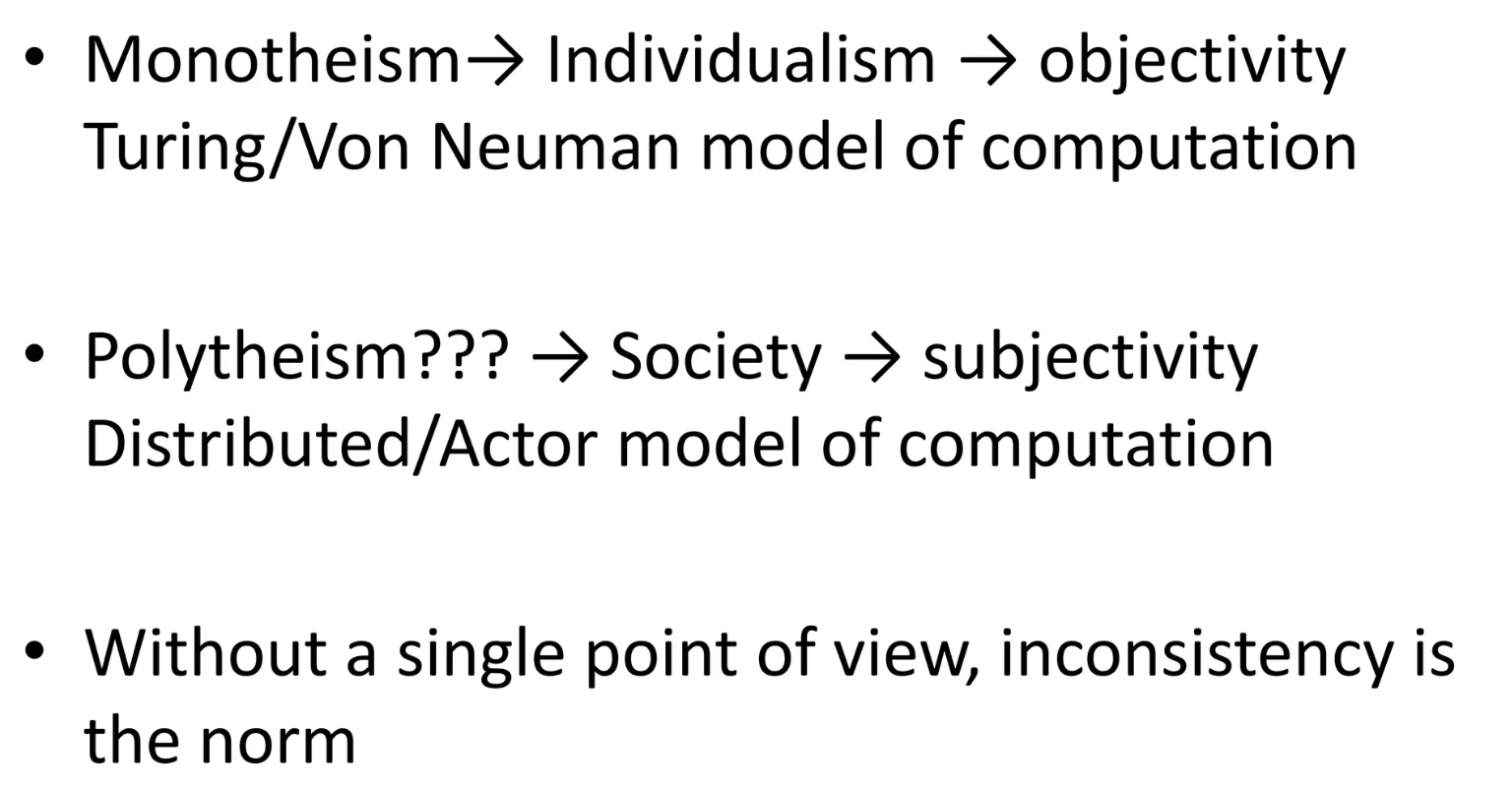
- My own presentation at the 2011 workshop was on Politics and Pragmatism in Scientific Ontology Construction, where I was lightly mocking the idea of consistent formal ontology. I also participated in a panel organized by Fanya Montalvo on the Singularity, and did a short presentation on How to Avoid the Singularity, apparently I was taking pokes at rationalists even back then. This talk was trying to connect Hewitt's ideas with Latour, in a jokey way.
Links with Latour
- It's kind of funny that Latour's Actor-Network Theory is about as prominent in his intellectual world as Hewitt's Actors is in computation, yet the two don't seem to be very connected (Both died during 2022). Hewitt was aware of Latour at least, I asked him once about his thoughts on ANT and he said "we're implementing it!"
- Here's a Latour publication that acknowledges a Hewitt influence The Hume Machine: Can an association network do more than formal rules?