


Protocols
29 Sep 2025 - 27 Oct 2025
- EntryPoint for Protocol-related stuff. Maybe start at Protocols/Protocol Thinking, or choose your own adventure on the left.
PostHog is the open source Product OS - it's a suite of product and data tools, built on the modern data stack. We provide product analytics, session recording, feature flags, A/B testing, event pipelines and a data warehouse. PostHog can be deployed to the cloud, or self-hosted on existing infrastructure, removing the need to send user data to a 3rd party.

The agency of an individual or group—the set of actions available to them—determines which protocols they can engage with. This, in turn, determines which protocol-mediated parts of the built environment they can interact with as mere consumers and which they can shape more fundamentally. This agency, of course, differs for everyone and even varies for a given party over the course of a day, depending on their spatial and temporal circumstances. But it is always subjective.
Protocols are touted as a liberating alternative to the walled technological gardens that govern our lives: an eluseive utopiza – centered around user freedoms instead of commercial interests
I think this is a fantasy...their purpose has always been to simplify coordination....they do not liberate us, but rather seek to control us completely.
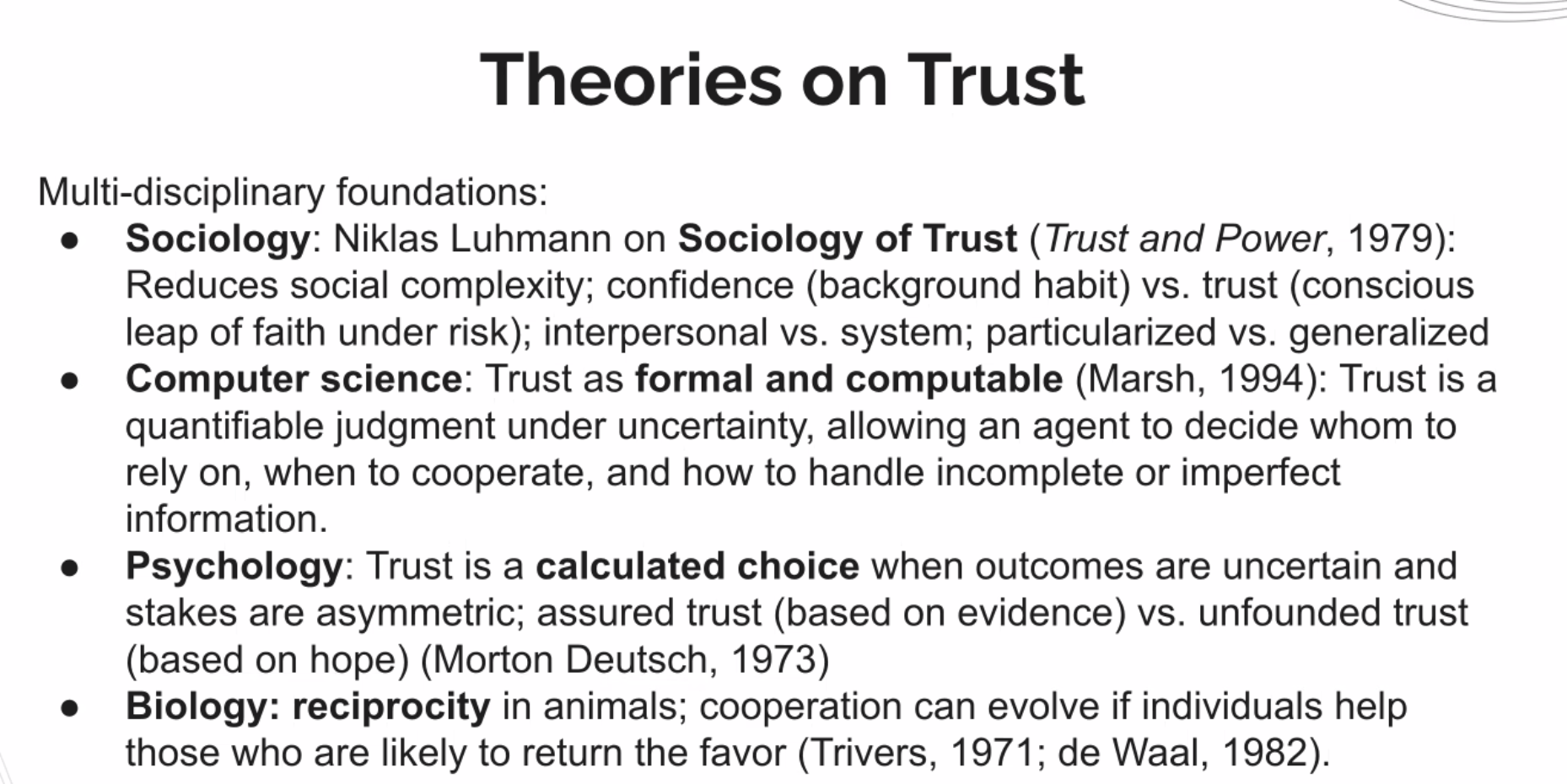
protocols reduce the number of decisions that need to be made
protocols gain legitimacy from participation
protocols resist central management
On the internat, we are part of swarms: networks of people, bnots, and content, coordinated through algorithmic feedback loops. Swarms are harbingers of misinformation, heralds of mutal aid, and representatives of the public will....most importantly, they can act collectively without explicit protocols.
Sarah Friend is one of the most creative, engaged, and critical voices in the field of new digital art and its discourses. As an artist, technologist, and software developer, she works at the imbricated fringes of art, finance, and blockchain technology. We are proud to announce Friend's first solo exhibition at Nagel Draxler, Terraforming, which marks the beginning of our gallery's representation of this outstanding artist.
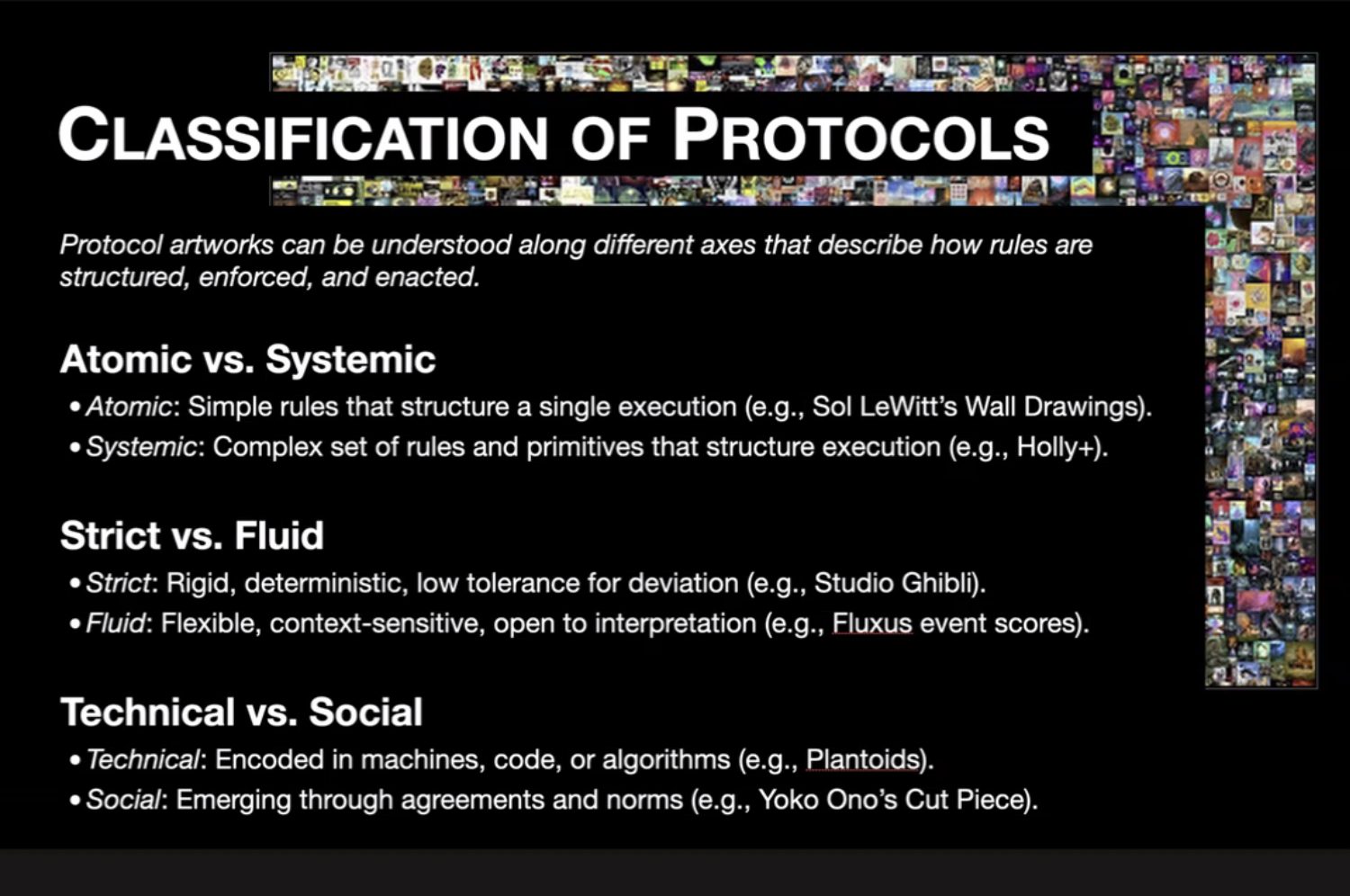
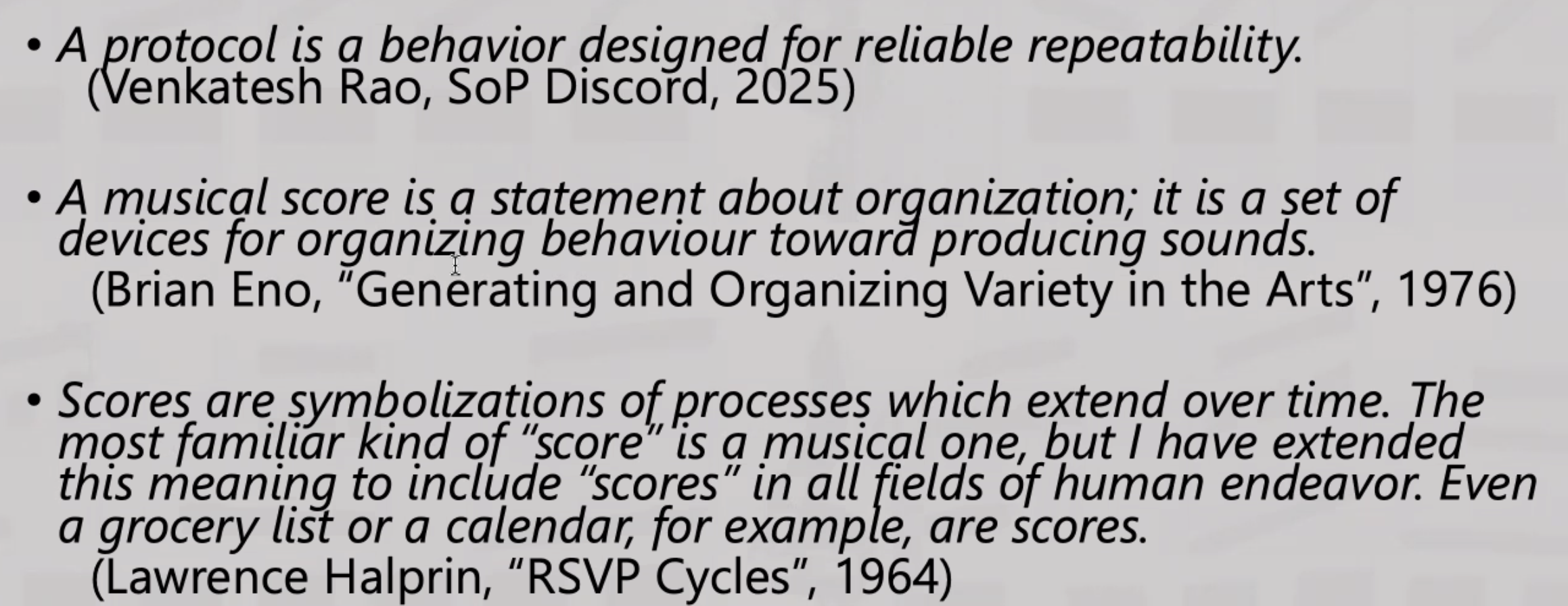
A protocol is a stratum of codified behavior that allows for the construction or emergence of complex coordinated behaviors at adjacent loci.
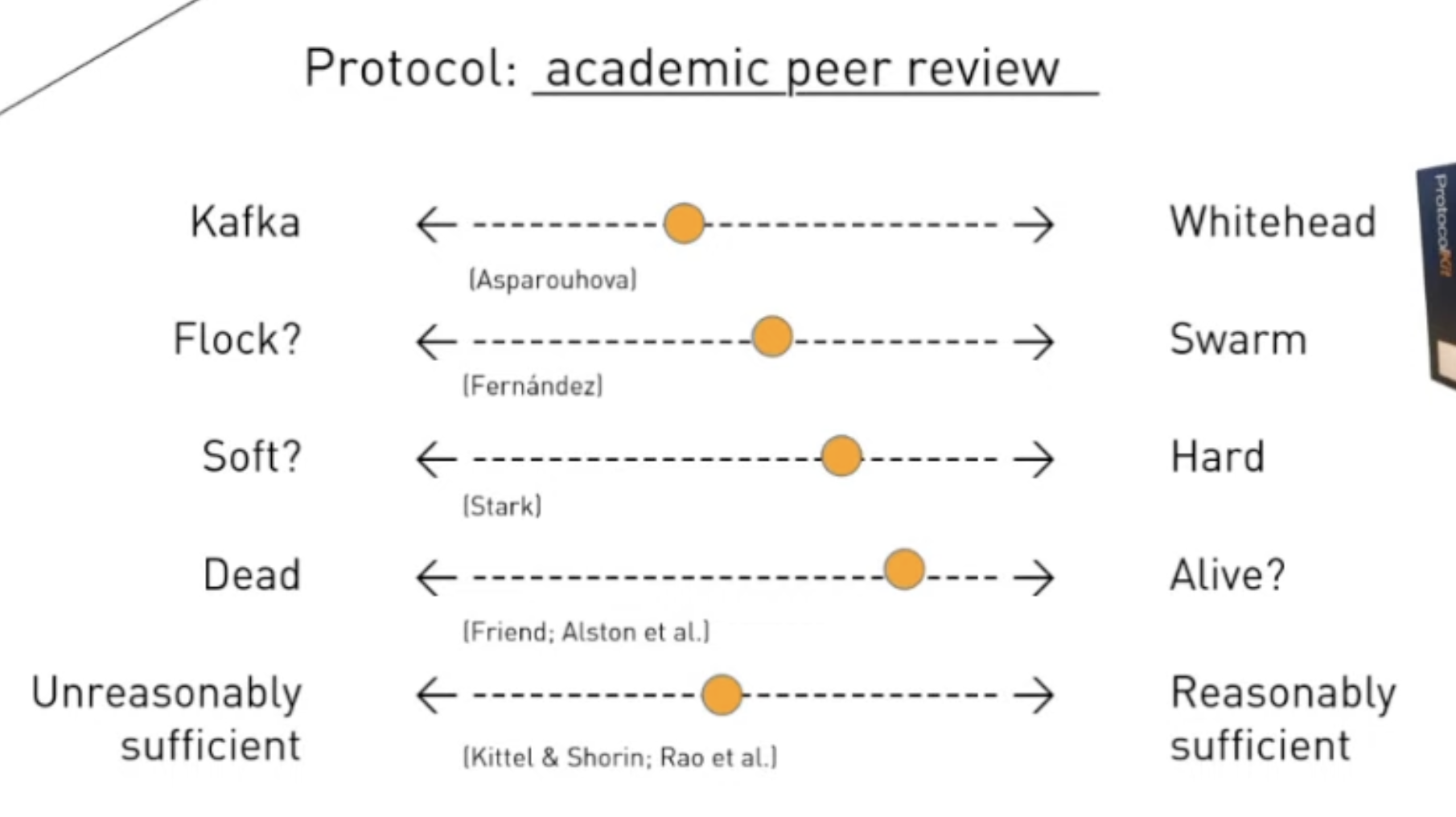
Protocols, therefore, are the very embodiment of A. N. Whitehead’s observation: “Civilization advances by extending the number of important operations which we can perform without thinking of them.”
think of it like an extremely high-stakes flow chart: If this, then that.
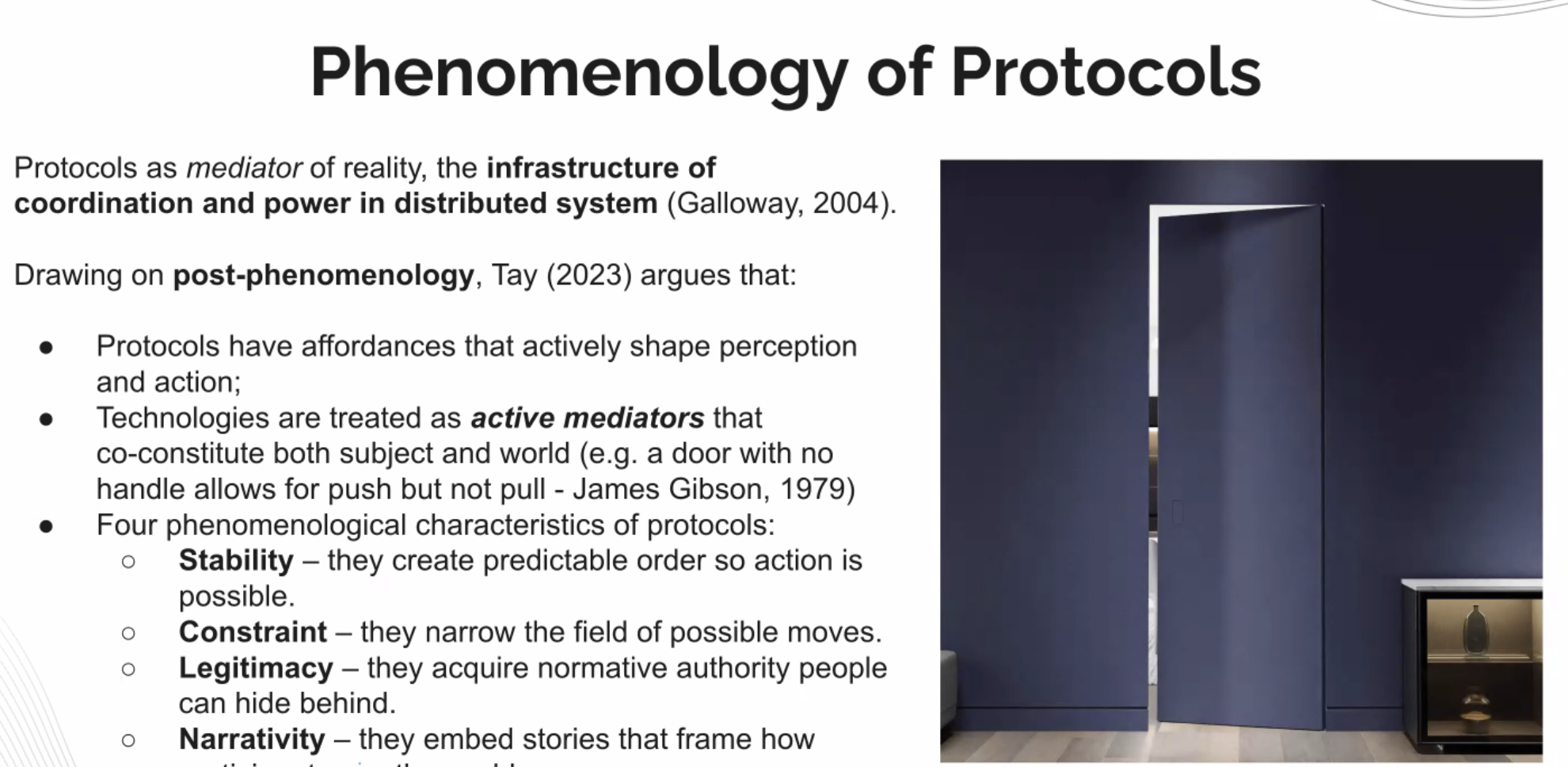
Almost everything around us, in technologically modern environments, comprises “engineered arguments” that resemble urban traffic in their phenomenology.
A 'good' handshake, according to Vanderbilt, is 'elbow level, firm, and brief' (1972:241). Post says, The proper handshake 'is made briefly, but there should be a feeling of strength and warmth in the clasp' (1940:23). Bad handshakes include the bone crusher — the grip that makes the other person, especially a woman wearing rings, wince. Or a limp, damp handshake that seems to say, 'I am not really happy to meet you at all!' Or it may be the kind of straightarm shake that seems to hold the other person off or the octopus grip that draws you inexorably toward the shaker, who never seems to want to let go.
"A major lesson of cryptocurrency protocols is that when you design something with a trust-minimized architecture, people approach it with a mercenary perspective."
"I recognize that universal money protocols optimize for certain forms of coordination while systematically undervaluing others. What protocols would better track and reward the things I think actually matter?"
So I went to Burning Man for the first time, and it was quite as amazing and overwhelming as I had hoped. I don՚t think I՚m going to go into details here. But I have to note that the fundamental thing about this event, which everybody knows but is not often made explicit, is that the whole thing is conceived, designed, built, and populated by people who are tripping balls most of the time (with exceptions). **Black Rock City thus mirrors one of the more interesting phenomena of drug use: that a mind (or city) can be completely fucked up and yet still manage to perform most of the necessary operations to sustain daily life. I can՚t quite explain how this works, but in both cases it seems to say something about the robustness of the system architecture, for lack of a better term.** A normal computer, by contrast, can՚t tolerate even a single component going wrong.
[ Rituals ] turn the world into a reliable place. They are to time what a home is to space: they render time habitable.
Where the cyberpunk hero was a lowlife maverick outsider who typically had to hack their way to technological agency from an external locus, what we might call the protocol punk hero operates from within a protocolized environment where boundaries separating insides and outsides are increasingly meaningless...The protocol punk hero is an archetype that merges the 1950s style insider bureaucrat hero5 and the 1980–90s style outsider maverick hacker hero.
When everything is inside the belly of the technological beast, there is no “outside” or “underbelly.” There is only a range of postures of greater or lesser agency that one can adopt while on the inside. The greater the attunement to the protocolized environment, the greater the agency. The greater the attunement to mere technocracy, the lower the agency.
Social protocols are codified procedures that coordinate human behavior...timekeeping is a device-mediated social protocol
It's a bit hard to appreciate today, when every toaster is connected to the internet, how visionary and forward-thinking Hewitt's thinking about distributed computing was in its day. Basically he foresaw this world and tried to develop intellectual tools for building and controlling it.
... an approach to modelling intelligence in terms of a society of communicating knowledge-based problem-solving experts. In turn each of the experts can be viewed as a society that can be further decomposed in the same way until the primitive actors fo the system are reached. We are investigating the nature of the communication mechanisms needed for effective problem-solving by a society of experts and the conventions of discourse that make this possible.
This was the big hit, and I've not been the same since. ...Bob Barton, the main designer of the B5000 and a professor at Utah had said in one of his talks a few days earlier: "The basic principle of recursive design is to make the parts have the same power as the whole." For the first time I thought of the whole as the entire computer and wondered why anyone would want to divide it up into weaker things called data structures and procedures. Why not divide it up into little computers, as time sharing was starting to? But not in dozens. Why not thousands of them, each simulating a useful structure?... It was the promise of an entirely new way to structure computations that took my fancy.
Again, the whole point of OOP is not to have to worry about what is inside an object. Objects made on different machines and with different languages should be able to talk to each other—and will have to in the future. Late-binding here involves trapping incompatibilities into recompatibility methods
In November [1972?], I presented these ideas and a demonstration of the interpretation scheme to the MIT AI lab. This eventually led to Carl Hewitt's more formal "Actor" approach [Hewitt 73]. In the first Actor paper the resemblance to Smalltalk is at its closest. The paths later diverged, partly because we were much more interested in making things than theorizing, and partly because we had something no one else had: Chuck Thacker's Interim Dynabook (later known as the "ALTO").
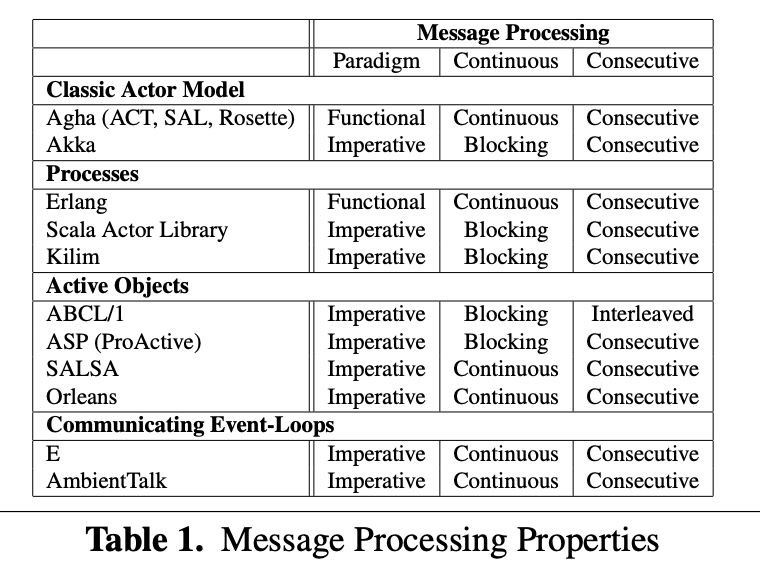
To the best of our knowledge, the first attempt to provide compositional verification and model checking support for an imperative actor-based language is the introduction of Rebeca in 2001
ARC (Actor-Role-Coordinator)[94] and PAGODA (Policy And GOal-based Distributed Architecture) [115,116] are two actor-based coordination models in which meta-actors control interactions of actors.
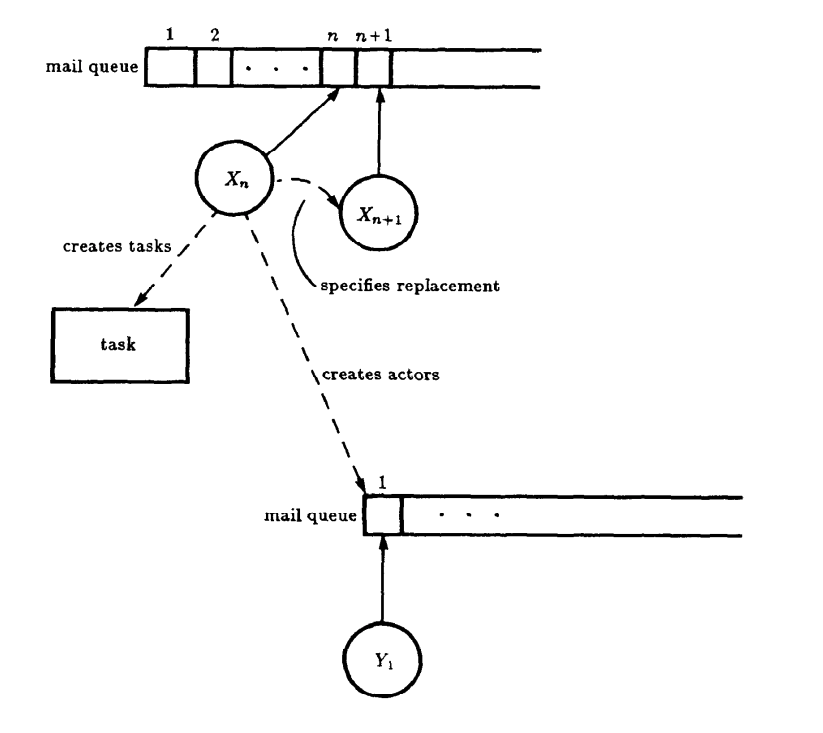
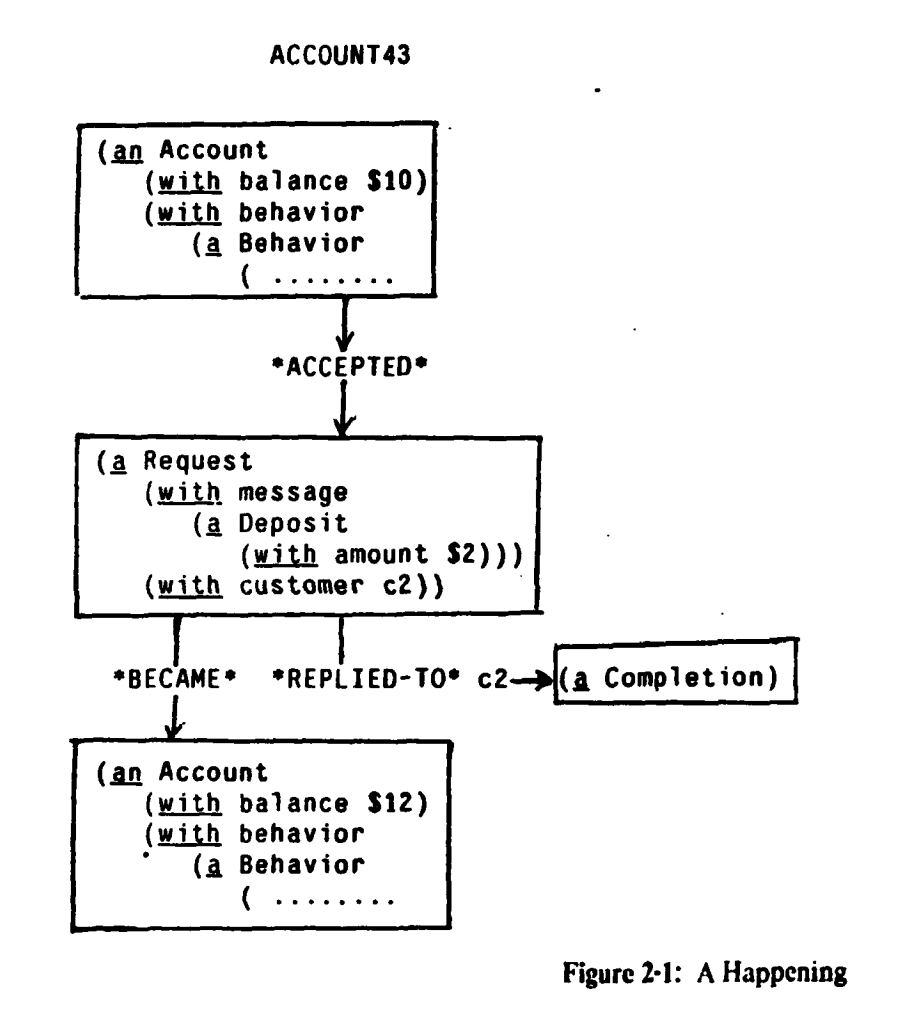
In the Actor model, computation is conceived as distributed in space where computational devices communicate asynchronously and the entire computation is not in any well-defined state. (An Actor can have stable information about about what it was like when it receives a message.) Turing’s Model is a special case of the Actor Model
Active messages support cooperative behavior on collections of configurators. An active message is a message which, when received by a configurator, switches execution roles with the configurator.
Whether we post a letter, wait for a train, or draw a cheque, our action is in each case orientated towards a complex network of human action of which we know enough to make it serve our ends, though we may know next to nothing about the internal working order of these institutions. We know of course that such an internal working-order exists, but in our everyday life take no interest whatever in its details. We know very well that the Post Office works according to a general plan, but such knowledge as we have about it is usually quite irrelevant to the achievement of our purpose in posting a letter. Only a few aspects of this general plan, perhaps the times of collection and delivery of mail, need be of concern to us.
Lavoie argues that ‘entrepreneurship should be conceptualized as a social process of mutual orientation.’ He argues that ‘Our ability to coordinate with one another may depend on our capabilities for mutual orientation, to see not the things themselves, but to see how one another are seeing things.’ The focus on mutual orientation suggests that we shift our attention to how market participants articulate and share meanings, and how they negotiate shared categories that orient their actions....As we have seen, abstraction boundaries are the key to flexibly combining complementary activities. The process of ‘specifying’ and ‘fitting’ requires both the discovery of an abstraction and the creation of a boundary that allows it to connect to complementary activities. Entrepreneurs must look beyond existing categories to specify new solutions, yet at the same time fit the new solution into a pattern of complementary activities.
The move from procedural programming to object-oriented programming can be seen as a move from concrete plans to abstract plans. Objects do not coordinate their actions with the specific plans of other objects; they coordinate their actions to the abstract aspects of those plans. An object’s interface abstracts from a specific plan to a kind of plan. Object-oriented programming, or more generally the move to encapsulation, message passing, and polymorphism, is essentially trying to move from plan coordination to pattern coordination...
We recast Lachmann’s explanation of the institutional order in terms of the concepts of abstraction and modularity borrowed from computer programming. Economists, largely under the influence of Herbert Simon, have examined the role of modularity, but they have ignored the twin concept of abstraction. Simon emphasizes the role of modularity in decomposing complex systems, but programmers also emphasize the role of abstraction in composing them. The programmers’ challenge of composition can be viewed as analogous to economists’ problem of plan coordination. We argue that not only do the concepts of abstraction and modularity provides a better foundation for Lachmann’s theory of the institutional order, but they provide a natural link to Hayek’s work on abstract orders.
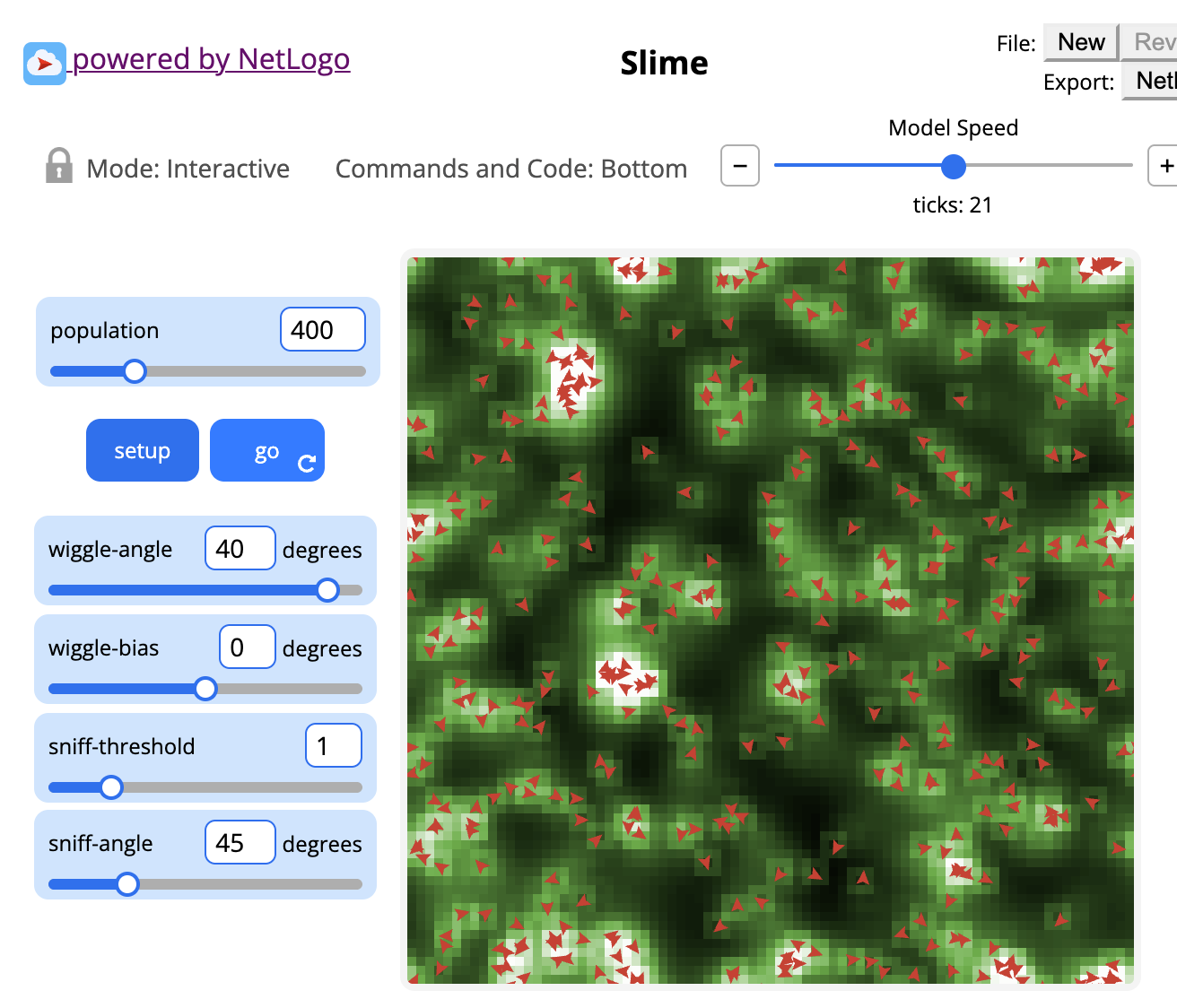
to go
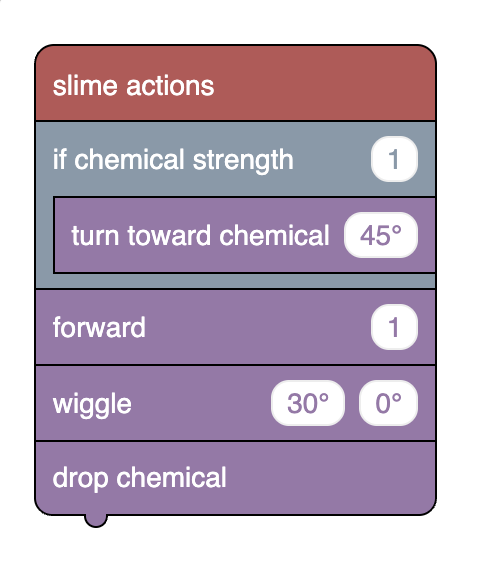
ask turtles
[ if chemical > sniff-threshold ;; ignore pheromone unless there's enough here
[ turn-toward-chemical ]
rt random-float wiggle-angle - random-float wiggle-angle + wiggle-bias
fd 1
set chemical chemical + 2 ] ;; drop chemical onto patch
diffuse chemical 1 ;; diffuse chemical to neighboring patches
ask patches
[ set chemical chemical * 0.9 ;; evaporate chemical
set pcolor scale-color green chemical 0.1 3 ] ;; update display of chemical concentration
tick
end
Protocols of street protest. Write something about that. Also maybe include something from Erica Chenoweth research, apparently she did a quantitative study of what scale of protest you need to be effective
Here is one of my personal observations, please expand on them: The location (in this case, Tesla dealerships, so very distributed) is a schelling point or nucleation site
Another personal thought, please expand: there are impromptu signalling protocols, like people who drive by honking to show either approval or disapproval. The problem is that there is no way to tell which it is! How could protocol thinking be applied here? It's mostly approval I think, the hostile ones gun their engine or yell obscenities.
Another thought: I'd like to say something about the experience of protesting, the phenomenology of it, what it feels like. It is empowering in tiny ways, it discovers and creates local community (in a very mundane way, nothing magical here). Showing up to a physical place is a lot different from flaming on the internet, my usual form of political activity. It shows not only individual commitment, but creates a group commitment since your commitment is visible and shared with others. This seems really important and fundamental, I wonder what protocol theory has to say about it.
I alway feel kind of weird and stupid being part of a mob, yet it also feels like I am performing a civic duty. Even stranger, I feel like I am enacting a role in a collective being of which I am but a part – and feel perfectly OK about it. I am giving my positive assent to this collective being, Co-creating it. This triggers my long obsession with group agency, and the ontological status of collective beings. What's the protocol take on that?